
Fasting Rules
A consice overview of food and fasting rules among the Old Orthodox.
The history of fasting rules, and the rules regarding food and those elements of life that go along with its preparation and service, are not historically consistent. Different variations on these themes, applied in varying ways, appeared in our history in different times and places.
Here, I will give a short overview of some ideals, the rules set forth by some communities that clearly embody principles of Christian living. They may not all find equal observance or emphasis among all Old Believer communities, and certainly will not find universal observance on an individual level. Yet, they are instructive as clear standards by which to live.
At the very foundation of a Christian’s life is fasting. By it, the Christian consistently practices self-restraint and learns to control and overcome the flesh. There is more ascetic ink spilt over the foundational importance of fasting before even any of the other passions can be uprooted, that I will not review them here. Fasting is universally demanded of the Orthodox Christian - with no exceptions.
Before explaining the different kinds of fasting categories, it is necessary to say a few words about food culture, in general.
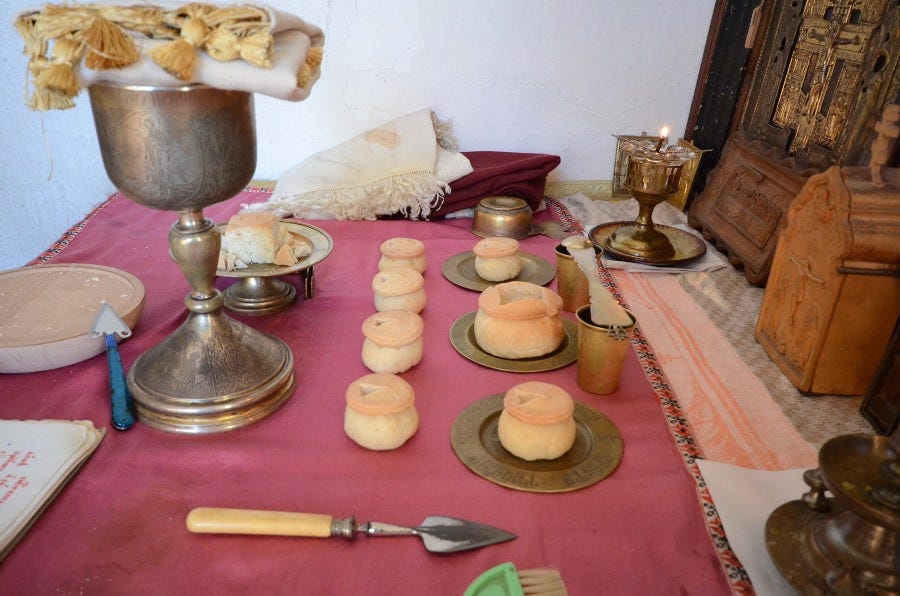
Non-fasting Days. Skoromnaya Food.
For non-fasting days, the Christian is not restricted beyond strangled animals, blood, or sacrifices, which are prohibited in all instances.
Absent from fasting restrictions, the Christian is still, on all days, bound by certain rules of moderation, which in today’s world seems outright ascetic. On normal days, the Christian must not eat more than two meals per day. At most. And eating in between meals is forbidden, even being considered a form of theft. From the 1805 Book of Christian Living:
Christian life is a constant practice of abstinence and patience, including in matters of food. A Christian may eat no more than twice a day, typically at lunch and dinner, unless it is a fasting period (where special rules apply). Whoever eats more frequently is separated from church services for two weeks, during which they must perform 1,500 prostrations. Those who lack restraint in eating are called “secret eaters” and gluttons by Scripture, having exchanged the salvation of their soul for the “pleasure of the throat.” If someone eats before lunch or before dinner, they must pray for this sin with 300 prostrations or perform 16 prostrations daily for six months. The venerable Abba Dorotheus said, “If a person has ten good deeds and one evil one, often the single evil deed overshadows the ten good ones. As a person eats without restraint, so the Devil secretly devours their soul.”
To get a sense of where this severity comes from, consider that the Old Orthodox Christian is forbidden to share meals with heretics. Again, from the Book of Christian Living:
It is not fitting to eat at the same table with non-believers. One must diligently avoid this, as the table, like a vessel, represents a unity. Every Christian meal is akin to a sacred table. A heretical table lacks sacred meaning—it is a lawless table. An Orthodox Christian cannot partake in such a meal, nor should they allow heretics or non-believers to join their own table…
At the table, one should sit in silence, recite the Jesus Prayer, and keep in mind the fear of death. It is a great sin to sit at the table and engage in idle or jesting conversations. Such a person, according to Holy Scripture, has turned away from God, and God has turned away from them; their prayer is not accepted, and all their labors are in vain.
The principles laid out in the above restrictions are one: the Christian meal is a kind of sacred act, and the sharing therein a form of Christian communion and unity. Thus, to eat alone, “in secret”, is to bypass the spiritual purpose of the meal, which is communal and religious in its inner meaning and purpose.
Referenced above is the requirement that the shared Christian meal be eaten in silence. In the old tradition, even found in common prayer books, is a rite, instructing that if one arrives to a meal after it has begun, the elder at the table will announce, “An angel is at the table,” to which the others will respond, “standing invisibly”.
This rite comes from the book Golden-mouth (Zlataoust), from a story about a vision of the elder Niphon:
Once, the venerable father Niphon was walking and saw a man sitting at the table eating with his wife, children, and those sitting with him at the table. He saw before them youths, beautiful in white robes, standing in the sanctuary of that place, as many in number as those eating, and likewise as many youths standing. The ones eating were poor. Seeing this, the servant of God was amazed and said, “O wonder! What is this, that those sitting are poor and needy, yet those standing before them are so radiant in bright robes?” He could not comprehend this. And God revealed to him who the resplendent youths standing before them were — they were the angels of God.
They have such a role, to stand in silence before those eating at the table during mealtime, as blessed servants of God. But when idle, foul, slanderous, blasphemous, or any ungodly speech begins to be uttered at the table, or if anyone starts to curse (complain about) the food: just as smoke drives away bees, so do inappropriate and evil words and conversations drive away the angels of God from the table. With the departure of God’s angels, dark demons come and sow all kinds of evil among those dining, and pour stinking smoke upon them from the words uttered at the table, and from the wicked conversations. And having said all this, the holy angel informed holy Niphon, who was astonished and said: “Truly does the apostle Paul write, saying: ‘Brothers, whether you eat or drink, do everything for the glory of God’”. To our God be glory, now and ever, and unto the ages of ages, amen.
The purpose of the silence reinforces the original principle: the meal is a sacred Christian act. Such acts are nowhere else accompanied by idle chatter. The meal is an act of piety, which should transform otherwise mundane events into sacred ones.
Beyond these rules, there are even others, whereby the Old Orthodox Christian should not partake of food made by heretics, or even to allow such to eat from the same vessels. These are promoted with varying degrees of vigor, but still have the purpose of supporting the meal as a pious, communal acts among believers.
Days without food restrictions are called “skoromnaya”, which mean “rich” or “fatty” - contrasting with the lenten days, which are “lean” (“lenten”).
Dry Eating
By default, unless “upgraded” for the festiveness of the daily commemoration, all fast days are “dry”.
Those foods are dry that are uncooked. In its stricted sense, “dry eating” means raw food only. Forbidden also on these days are all meats, oils, dairy, and wine (alcohol), all of which make a meal “rich”.
Dry eating also means that meals may not be served hot. In this sense, “cooked” takes on a character of “from the stove”. Some, in interpreting this rule, allow some foods that meat the dietary guidelines to be pre-cooked, and then served later, either cold, or at room temperature.
On all fasting days, the normal rule about two meals per day is reduced to one. So, on fasting days, the Christian should eat once.
To some, this may sound close to barbaric for those in the world. However, when it comes to long fasting periods, like Great Lent, this approach is a life-saver for non-monastics. In a family setting, during the fasts, it is typical to be consumed with thought of foods - what to make for the multiple meals, what to serve as snacks. The eating habits of modern man are, even when practiced moderately, already gluttonous. This makes the stress of the fasts one of how to still have a filling table of tasty food for our meals, only with different, less satisfying ingredients.
But to be restricted to the raw - a maximal restriction, has the unexpected effect of being maximally liberating from the stress of the fast, because one then approaches food in its simplest form. Any fruits of the earth may be used for our sustenance, and when taken simply, and sparingly, one can more easily foster a sense of thankfulness for the produce that grew from God’s benevolence.
To embrace the “dry food” is to reject the stresses and distractions of constant meal-planning during the fasts!
Food Without Oil
The next category of food sees no difference of permitted ingredients from dry eating, save that it can be cooked and served hot.
Food With Oil
On these days, one may observe all that is permitted on days without oil, but with the additional allowance for the use of oil and wine, and on some days, some kinds of seafood.
It is not the case that in the Old Believer traditions that shellfish may be consumed at any time. Whether this was because the availability of shellfish was not abundant as it was in the Mediterranean lands, or because its allowance was regional in the Greek lands, is something I do not know.
Food with Fish
This is the most permissive of the fast day categories, which allows all that was permitted on days “with oil”, but all seafood is permitted as well.
The meal on these days coincides with great feasts, and during Great Lent, for example, this level of fasting is only permitted twice - on the Anunciation, and on the feast of the Entry into Jerusalmen (Palm Sunday).
The Fasting Periods
Nativity Fast
On November 15th, a forty-day fast begins in preparation for the feast of the Nativity of Christ, which occurs on December 25th (old-style). The beginning of the Nativity Fast comes one day after the commemoration of the Holy Apostle Philip. This connection has given this fast the popular name “Philip’s Fast”
There are three main sections of the Nativity Fast:
From the beginning of the fast until the feast of St. Nikola (Nicholas) on December 6th (old-style); all days are “food with fish” days, except for Wednesdays and Fridays, which are “food with oil” days.
From the feast of St. Nikola until the Forefeast of the Nativity, on December 20th (old-style), fish days are only permitted on Saturdays and Sundays, and Wednesdays and Fridays are now “food without oil” days. All other days are “food with oil”
On the days of the Forefeast, the days are “food without oil” except for Saturday and Sunday, which are “food with oil.”
Apostles Fast
The fast dedicated to the labors of the Holy Apostles begins the day after the Sunday of All Saints (the Sunday after Pentecost), and ends on the feast of Ss. Peter and Paul, on June 29th (old-style).
During this fast, on Mondays, “food without oil” is permitted. On Wednesdays and Fridays, “dry eating” is observed.
On Tuesdays, Thursdays, Saturdays, and Sundays, “food with fish” is allowed.
Dormition Fast
On August 1st (old-style), the fast in preparation for the Dormition of the God-bearer begins, which is a strict two-week fast, second only to Great Lent in its strictness.
On Tuesdays and Thursdays, “food without oil” is permitted.
On Saturdays and Sundays, “food with oil” is allowed. This level is also allowed on the Feast of the Transfiguration.
Great Lent
During Great Lent, on Mondays, Wednesdays, and Fridays, “dry eating” is observed.
On Tuesdays and Thursdays, “food without oil” is permitted.
On Saturdays and Sundays, “food with oil” is permitted.
“Food with fish” is only allowed on the feast of the Annunciation and the Entry of the Lord into Jerusalem.
First Week of Great Lent
During the first three days of the first week of Great Lent, an especially severe fast is recommended - complete abstinence from all food. The purpose of this is to shock the flesh into submission so that it may not be a burdensome nuisance throughout the fast. By not observing this kind of strictness, due to the severity of the fast, the flesh will rebel, constantly fighting back against the restrictions, so that one cannot have the singular focus upon prayer and repentance that the Fast demands.
Holy Week
Not properly part of the Great Fast, but a separate one, Holy Week is close to the first week of Great Lent in its severity, with “dry eating” on Monday through Wednesday.
On Great and Holy Thursday, food without oil is permitted along with wine, in commemoration of the Great Supper.
On Holy Friday and Saturday, complete abstinence is observed, with no food permitted.
These rules, as I said at the beginning, are not the only historical manifestations of the fasting rules, but they represent the widely fostered standard by which Old Believer Christians have held themselves against. There are constant adjustments to these rules that account for festal commemorations, in which, as a general rule, adjusts the standard fasting observance by one degree or permission. Calendars should be consulted for specific adjustments that may appear in certain regions or groups.
These food standards represent an essential element of long-established Christian piety. The purpose of this, broadly speaking, is to make every element of our lives sanctified to God, to perpetuate in all our actions the remembrance of Him, and, in the specific realm of food, to subjugate the flesh unto the freedom of the spirit.