
The Priestly Blessing
This is a quick article on the rite of the priestly blessing. This rite is rather more involved than what it has become in the New Rite Church, as you will see in the second half of the article. Given the formality and the spiritual meaning behind it, it is not customary among Old Believers to ask for blessings from priests and bishops every time they see them.
It may be added to this article that when someone receives a blessing from a priest according to the old tradition, the priest or bishop will make the sign of the Cross upon that person, touching their head, their belly, and their shoulders, and will never do so without giving the verbal benediction quoted in the article. It is done with great care and intention.
In this article, there is an explanation of the word “blessing” in Church Slavonic - which is “благословение”. This word, like its Greek (εὐλογεῖν) and Latin (benedicere) counterparts, is a compound word, and stands in contrast to the English word “bless” which comes from the Old English “bletsian”, meaning to make holy or consecrate by a religious rite. The meaning of the English word has certainly conquered the original meanings of the words in the ancient languages.
"And no man denyeth, but that he which is lesse, receaueth blessynge of him which is greater."
— Hebrews 7:7 (from the 1539 Great Bible)
The word "blessing" consists of two parts: "good" and "word" — speech, teaching, and in this context, also agreement and permission (for this or that "good"). Therefore, a blessing is, in modern language, consent and permission for a specifically defined, God-pleasing, and salvific deed. Regarding which deeds are God-pleasing and salvific for us, we must be taught by God — the Source of all blessings — in the Holy Scripture and Holy Tradition.
The first general blessing to the human race was given by God Himself shortly after the creation of the world and the first humans (Genesis 1:28). Then, after the liberation of the chosen people from Egyptian slavery and the establishment of the Old Testament Church, the Lord, through the prophet Moses, taught how each person, a faithful son of the Church, should be blessed: "And the Lord spake unto Moses, saying, Speak unto Aaron and unto his sons, saying, On this wise ye shall bless the children of Israel, saying unto them, The Lord bless thee, and keep thee: The Lord make his face shine upon thee, and be gracious unto thee: The Lord lift up his countenance upon thee, and give thee peace. And they shall put my name upon the children of Israel, and I will bless them" (Numbers 6:22-27).
The Founder of the New Testament Church, the Son of God, the Savior of the world, by word and deed taught how the sons of the New Israel should be blessed. Before His Ascension into heaven, our Lord Jesus Christ "lifted up His hands and blessed" (Luke 24:50) the believers who surrounded Him. With this, He indicated that the holy apostles should also impart blessings to believers; and from the apostles, this power and ability were passed to bishops and priests.
St. John Chrysostom calls the blessing of sacred persons "a spiritual weapon, which makes the Christian safe from all sides..." (His Works, vol. III, p. 53). The bishop's and priest's hand, during the performance of the greatest Sacrament of Holy Communion at the Divine Liturgy, transforms the bread and wine into the Body and Blood of Christ through the invocation of the Holy Spirit, brings a person into eternal life during immersion in the font of Holy Baptism, and brings down God's blessing in every place and at every time on those who receive it worthily and reverently. Indeed, not only in important matters and undertakings associated with danger, but also in ordinary everyday activities, the blessing of sacred persons sometimes exhibited remarkable power. For example, St. Gregory the Dialogist [St. Gregory the Great for you Latins -OB] tells of an incident in a monastery where they were building a structure. They needed to lift a very large stone. A multitude of workers was gathered for this, but they could not accomplish the task. Then they called upon the holy Benedict, the abbot of the monastery, and as soon as he, after prayer, gave his blessing, the stone was lifted with such ease as if it had no weight at all (St. Gregory the Dialogist, Book 2, Chapter 9).
It is possible that with the current mindset, people might say that such power of priestly blessing belonged only to saints, not to ordinary sinful pastors. To this, it should be said that indeed, priests are "subject to like passions as all men," and therefore every clergyman, performing the Holy Mysteries, humbly prays that the Lord may cleanse his unworthiness. And those who doubt the power of priestly blessing should remember that the Lord said: "And these signs shall follow them that believe" (Mark 16:17). Therefore, those who ask for a priestly blessing without faith sometimes do not receive the desired success in their affairs. And this happens not because of the unworthiness of the priest but because of the lack of faith of the one asking; for no matter what the priest may be, he performs God's work, which he has received the blessing from above (in the Sacrament of Ordination), and is merely an instrument of this grace.
Through priestly blessing and, of course, primarily through episcopal blessing, the Lord invisibly sends every good thing to those who sincerely and diligently ask for it "for good" (James 4:3) and receive it with faith. The Holy Fathers write that anyone who treats priestly blessing with disdain is a godless person and denies Christ, who appoints priests (St. Ignatius the God-Bearer).
In the ancient Church, as seen from history, Christians highly valued the blessing hand of the priest, bringing their children under it and reverently kissing the blessing hand themselves.
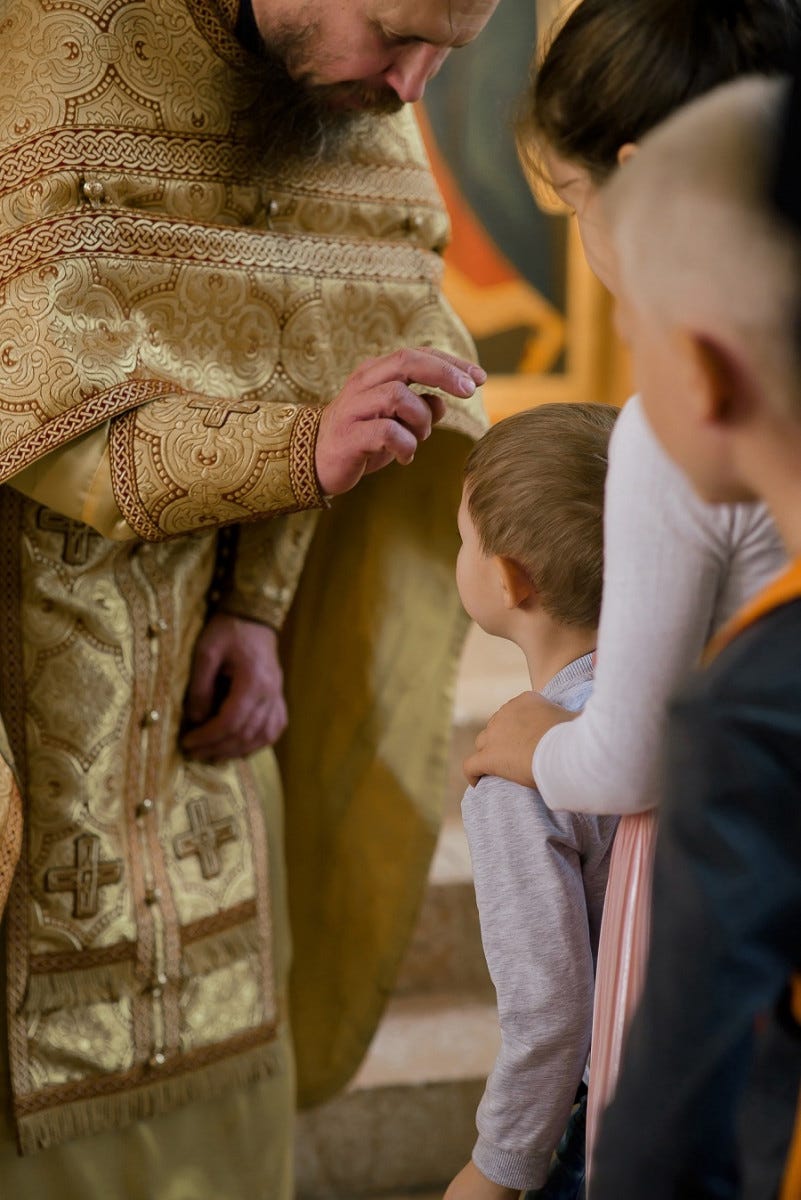
For by doing this, we turn more to God than to man, asking, thanking, and praising Christ, who works through the "instrument of grace" — the sacred person. The book "The Son of the Church," speaking of this action, gives the following instruction: "Receive his blessing (i.e., the sacred person) with honor and joy... When you receive this (i.e., the blessing), kiss his hand; if he does not offer his hand to you for kissing, ask and beseech him to allow you to kiss it" (Chapter 64).
The "fruit" of the blessing depends more on the one asking, on their faith and worthiness, than on the one blessing...
For information and as a reminder, it should be noted that men who do not want to wear beards, those who smoke tobacco and other such soul-destroying drugs, those who defile their tongues with abusive curses, filthy, rotten words (Ephesians 4:29), and those who are subject to other unseemly habits that disgrace the Christian calling, women and maidens who are in a state of impurity (menstruation), as well as the female sex (except for young maidens) with uncovered heads, should not ask for a blessing, and priests should not bless them if they dare to demand it. Otherwise, the power given by God to these pastors for the edification of the holy Church (2 Corinthians 10:8) will be used to destroy its saving statutes.
A very instructive story is found in the life of the holy martyr Protopriest Avvakum. The protopriest himself recounts that boyar Vasily Petrovich Sheremetev, while sailing along the Volga to Kazan with his family, called the protopriest onto his ship and ordered him to bless his son, "the barber." But the zealot of ancient piety, "seeing the image of fornication," did not bless him. The infuriated boyar ordered the protopriest to be thrown into the Volga and, "after much mocking, they pushed him off the ship." Thus, the holy martyr Avvakum preserved the gift of God's grace, so as not to give that which is holy unto the dogs or cast pearls before swine (Matthew 7:6).
Thus, even from this brief historical account and theological explanation, it is evident that receiving God's blessing through a true pastor of the Church of Christ is an holy, important, and salvific act for every faithful Christian.
Practically, this is done as follows. Without making the sign of the cross, one should bow to the ground before the clergyman and say: "Forgive me, holy master, and bless me" (if it is a bishop; if it is a priest, say: "Forgive me, honorable father, and bless me"). The pastor responds: "May God forgive you." The one asking for a blessing then says their name. After this, the one blessing makes the sign of the cross over the one asking and says the prayer: "The blessing of our Lord God and Savior, Jesus Christ, be upon the servant of God (or: handmaid of God, naming the person) always, now, and forever, and unto ages of ages." The one who has received the blessing responds: "Amen" and kisses the hand of the one who gave the blessing. Then the one who blessed says: "Christ is in our midst," and the one who received the blessing replies: "He is and ever shall be," and kisses him on the right shoulder, and again, without making the sign of the cross, bows to the ground.
For spiritual benefit, let us also say a few words about the "rite" of greeting Christian pastors (priests and bishops). Instead of the ordinary "Hello" or "Good day," when meeting a bishop or priest (even over the phone, regardless of who is calling whom), the younger should first say: "Forgive me, holy master (or: honorable father), and bless me." The elder responds: "May God forgive you; God bless you" (if there is dignity). Only then do they move on to the business part of the conversation.
When parting, it is not only inappropriate to say the customary "Goodbye" to spiritual persons, but all Christians should use the expression sanctified by the spirit of the Gospel teaching: "Forgive me for Christ's sake." In response, one should hear: "God forgive you. And forgive me." These words should be spoken not carelessly, not formally, but from the heart. For we ask for forgiveness for all in which we might have, willingly or unwillingly, grieved our neighbor, and we forgive him sincerely, with peace and love, praying that the Lord also forgive and have mercy on him.
It is customary to ask for forgiveness and blessings from bishops and priests in letters as well. Even the Apostle Paul concluded all his epistles with a blessing, invoking God's grace on all whom he strengthened in the Christian faith and virtue.
Thus, the forgiveness and blessing imparted by sacred persons are not merely formal rituals but spiritual gifts from above, from God Himself, which bishops and priests only transmit. And all of us, Christians, should treat this gift very seriously, responsibly, and reverently. Only in this case will God's blessing be effective and salvific in our lives. Then, according to the words of the Apostle Paul, the God of peace, who brought again from the dead the Great Shepherd of the sheep, through the blood of the eternal covenant, our Lord Jesus Christ, will perfect you in every good work to do His will, working in you that which is well-pleasing in His sight, through Jesus Christ. To Him be glory forever and ever. Amen (Hebrews 13:20-21).